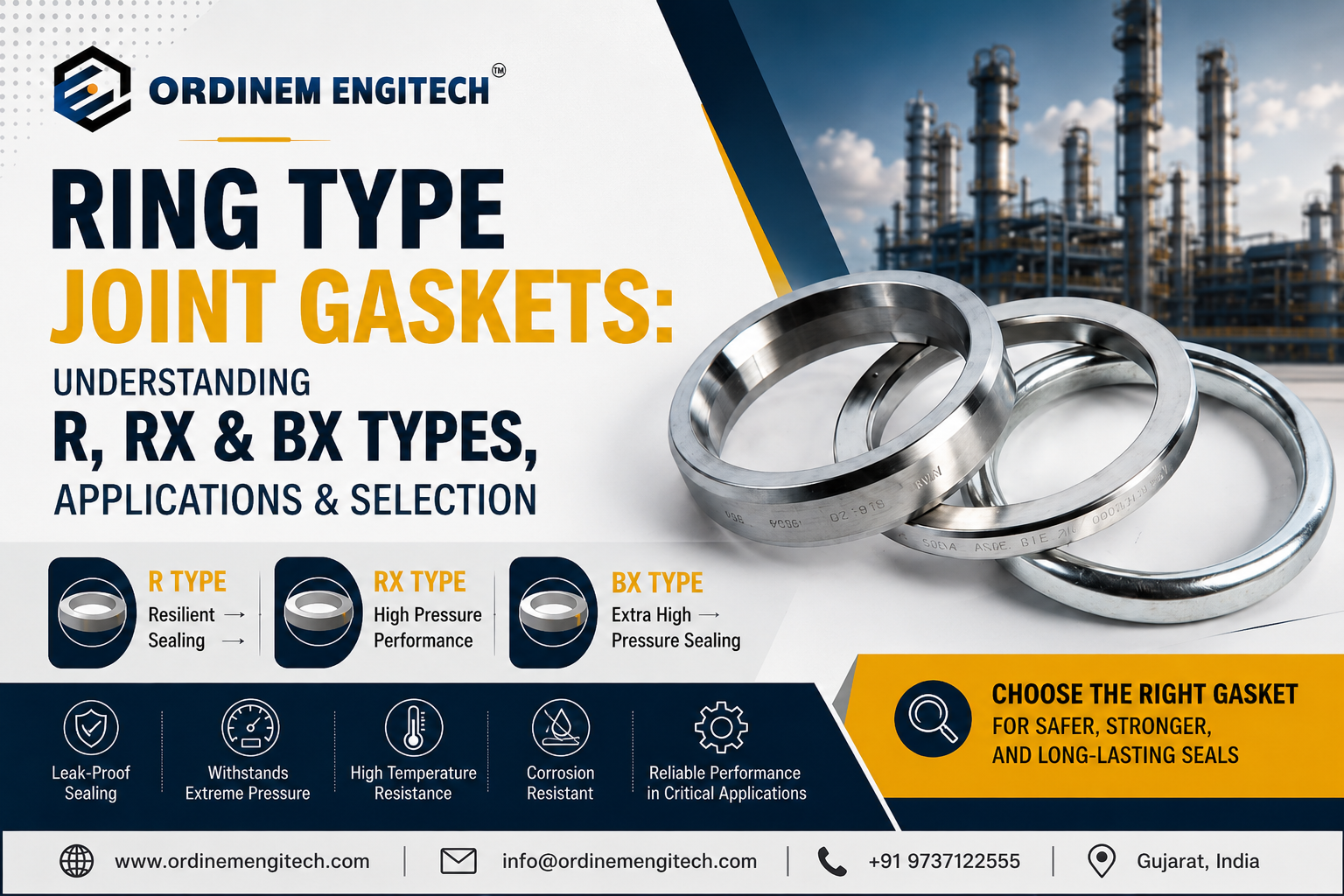
A Ring Type Joint (RTJ) gasket is a type of metallic gasket that fits into an RTJ flange groove. It is used mainly for use under high pressure and temperature service conditions where a strong metal to metal sealing is necessary. The three profiles mentioned are the R, RX and BX, and each of these is used for a particular type of flange, a particular pressure rating, a particular size and service conditions.
Ordinem Engitech Pvt. Ltd.produces and sells Ring Type Joint Gaskets in R, RX and BX configuration for challenging sealing application. The company provides various types of material and gasket to satisfy diverse industrial demands.
A Ring Type Joint Gasket is a precision cut or forged metal ring which fits into the RTJ groove on a mating flange. The gasket is compressed against the surfaces of the flange grooves during flange assembly, thereby forming a tight seal to prevent any loss of process fluid from the flange connection. Unlike soft gaskets and spiral-wound gaskets, RTJ gaskets are based on controlled deformation and contact between the metal gasket and the machined flange groove. They are thus widely used under pressure and temperature extremes. Metal Ring-Joint Gaskets are covered by ASME B16.20, which include materials, dimensions, tolerances, and markings. The standard also provides for dimensional suitability of referenced flange standards such as ASME B16.5, ASME B16.47 and API 6A.
The main RTJ profiles covered in this discussion are R Type, RX Type, and BX Type.
| Type | Main Characteristic | Typical Use |
|---|---|---|
| R | Basic RTJ profile; available in oval and octagonal forms | Standard RTJ flange connections |
| RX | Self-energising design with modified profile | Applications requiring enhanced sealing |
| BX | Pressure-energised profile with pressure-equalisation feature | High-pressure API 6BX connections |
The identification numbers for RTJ gaskets relate to flange size, pressure class, and the applicable flange standard. ASME B16.20 provides separate dimensional tables for R, RX, and BX ring gaskets.
The R Type Ring Type Joint Gasket is a basic and widely used RTJ design. It is available with oval or octagonal cross-sections and is selected for compatible RTJ flange connections.
ASME B16.20 sets a maximum surface roughness of 1.6 μm (63 μin.) for the sealing surfaces of R-type gaskets.
The modified asymmetric profile of the RX Type Ring Joint Gasket provides better sealing properties. It is self energising, and its profile is designed in such a way that the internal pressure can help to maintain sealing contact during operation. This design may be useful in application with pressure fluctuation, vibration and mechanical stress.
The gasket number and flange configuration should be verified before making a selection, as ASME B16.20 specifies dimensions for RX gaskets.
BX type Ring Joint Gasket is specially adapted for flange connections in accordance with API 6BX and is used with high pressure applications. It cannot be used as a replacement for R or RX gaskets as the groove and dimensional configuration is different. One important feature of the BX profile is its pressure equalisation hole/channel, which facilitates the equalisation of the pressure in the gasket arrangement. Depending on the flange and gasket specification, BX gaskets can be specified for pressures of up to 20,000 psi. They don't fit into R and RX grooves. The maximum surface roughness for BX sealing surfaces is 0.8 μm (32 μin.) as per ASME B16.20.
In most applications, RTJ gaskets are chosen for use in situations where pressure, temperature, and process conditions are demanding enough to warrant the use of a metallic gasket design.
Common applications include:
When sourcing RTJ gaskets, buyers should provide the flange standard, gasket type, gasket number, pressure class, material, operating temperature, and process media to the Ring Type Joint Gasket Suppliers. Providing these details helps the supplier identify a gasket that matches the flange configuration and service requirements.
Consider these factors:
ASME B16.20 specifically provides dimensional and tolerance tables for R, RX, and BX gasket types, making the applicable standard an important reference during selection.
| Feature | R Type | RX Type | BX Type |
|---|---|---|---|
| Profile | Oval or octagonal | Modified asymmetric profile | Pressure-energised profile |
| Flange compatibility | R-type RTJ grooves | R/RX-compatible groove arrangement as specified | API 6BX only |
| Pressure range | Depends on flange/gasket specification | Depends on flange/gasket specification | High-pressure API applications |
| Pressure energisation | Standard RTJ sealing arrangement | Self-energising characteristics | Pressure-energised design |
| Pressure-equalisation feature | No BX-style hole | No BX-style hole | Yes |
| Surface finish requirement | 63 μin. max | 63 μin. max | 32 μin. max |
The table summarizes the distinctions; actual selection should always be checked against the applicable flange and gasket standard.
Businesses that source RTJ sealing products must take into account their suppliers' ability, dimensional accuracy, material options, and quality control. Ordinem Engitech Pvt. Ltd. manufactures Ring Type Joint Gasket that are available in various configurations such as R, RX and BX and are provided in low carbon steel, 304, 316 and 347 stainless steel material. Customers can consult with the salesperson with regard to the type, material, size, pressure class and use conditions of the gasket to choose the appropriate sealing solution. The company is a reliable Ring Type Joint Gasket Manufacturers that emphasizes consistency in the quality of the products and manufacturing based on the requirements and specifications.
Ring Type Joint Gasket is a special type of metallic gasket which is used to seal an RTJ flange pair. Understanding the differences between R, RX and BX are important as each profile needs different dimensional and flange compatibility. R gaskets are available in oval and octagonal gaskets, RX is the modified profile for self-energising gaskets and BX is the special profile for API 6BX high-pressure flange connections. The highest pressure rated gasket is not necessarily the best gasket. The gasket needs to be the same as the flange, in terms of standard, pressure, process medium, material, dimension, and flange. Buyers should check the relevant specification and technical documentation before going for procurement for critical applications.
Ring Type Joint Gasket is installed in order to achieve a high integrity seal when joining compatible RTJ flanges, especially in high pressure and high temperature piping and equipment.
R gaskets are available in oval and octagonal profiles, while RX has a modified asymmetric profile with self-energising characteristics. The correct type depends on the matching flange groove and applicable specification.
The groove designs of RX and R gaskets are similar, but they cannot be interchanged without checking compatibility with the flange, dimensions and applicable standard.
BX gaskets are used on API 6BX flange connections and are related to high pressure applications. These cannot be replaced with R or RX gaskets.
In order to avoid hydrogen cracking. Sudden metal failure in H₂S environments, due to higher hardness.

 - +91 9737122555
 - info@ordinemengitech.com