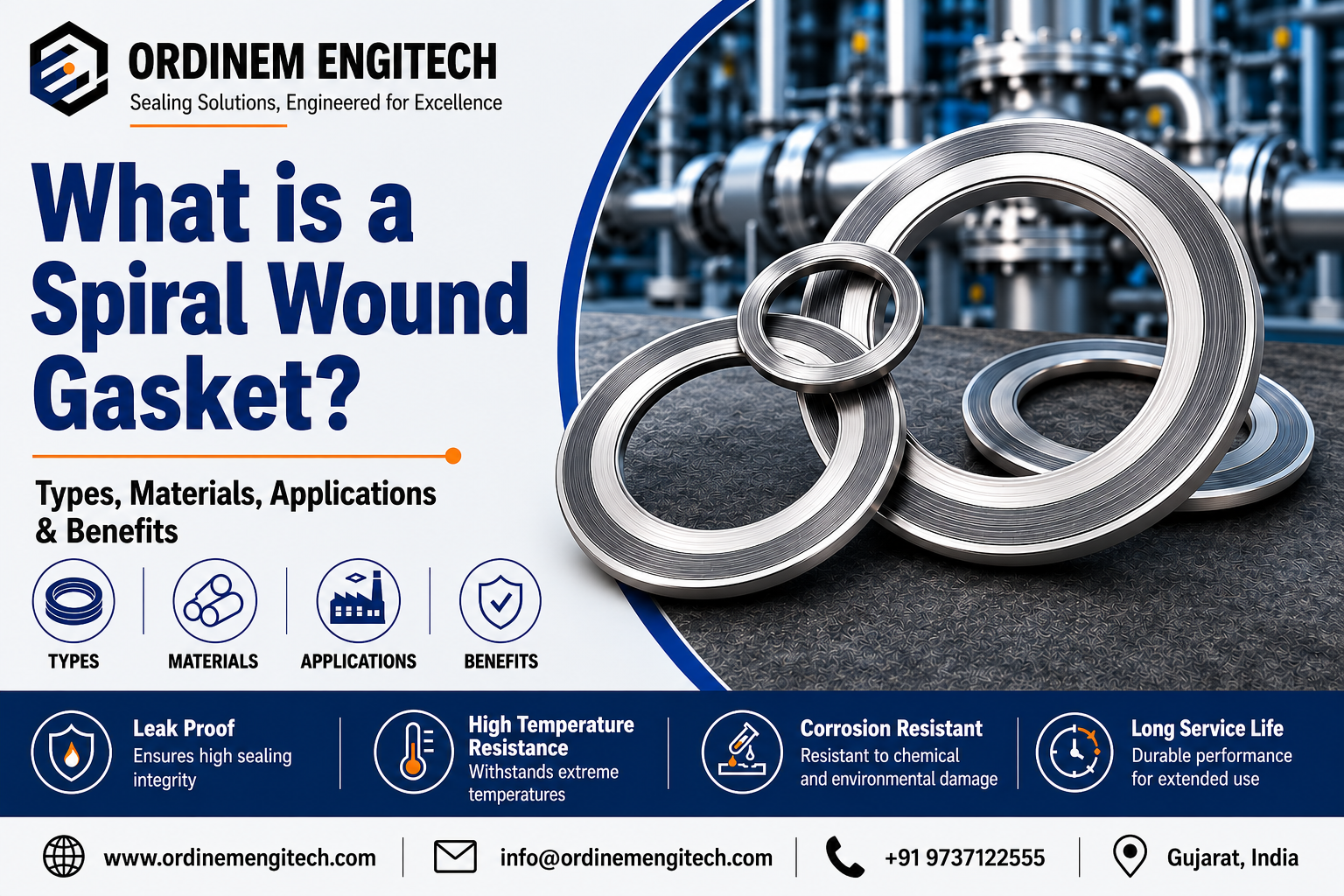
Spiral wound gaskets are one of the most widely used gaskets in industrial pipes that can be used in various high pressure, high temperature and harsh environments. These gaskets are used in various industries, including oil & gas, petrochemicals, power generation, pharmaceuticals, chemical processing, marine, and food processing, to ensure a safe and leak-free operation. Spiral wound gasket is created using soft material and metal windings together to make a flexible, yet strong gasket. Spiral wound gaskets are made from an alternating spiral winding of soft material and metal, which provides a flexible, yet durable gasket. This kind of design provides for a gasket that adjusts to irregularities in the flange and assures good sealing even when the temperature and pressure are variable. Ordinem Engitech (India) Pvt. Ltd is a trusted Spiral Wound Gasket Manufacturers and has a specialization in precision engineered sealing solutions that meet International Quality Standards.
The company has a wide selection of spiral wound gaskets in all sizes, material combinations and gasket configurations to satisfy different sealing needs, while providing reliable gasket performance and long gasket life. All gaskets are precision-made to provide a reliable seal in critical industrial applications.
Spiral wound gasket is a semi-metallic gasket, which is produced by winding a thin strip of metal with a compressible filler material in a spiral. The metal gives strength and resilience and the filler ensures the flange connections are leak-proof. Designed for particularly high pressure/extreme temperature use with raised face and flat face flanges. They have a special design that allows them to prevent loss of sealing when subjected to thermal expansion and contraction and recover from compression. Spiral wound gaskets are now being specified by the ASME B16.20 manufacturing standards and are commonly supplied to flanges produced to the ASME B16.5 standard.
The working principle of spiral wound gaskets is explained to understand why they are preferred in critical systems of industries. The gasket is made up of alternating layers of metal winding and soft filler which will compress when the flange bolts are tightened.
Here's how the sealing process works:
The flexibility and resiliency of spiral wound gaskets can help them excel in difficult applications as compared to many traditional gasket designs.
Different industrial applications require different gasket constructions. The most common types include:
The outer ring serves as a centering guide during installation.
Advantages include:
This is one of the most widely used designs for demanding industrial applications.
Benefits include:
Designed specifically for heat exchangers and pressure vessels where non-standard dimensions are required.
Material selection plays an important role in gasket performance. The metal winding and filler material are chosen according to temperature, pressure, and chemical compatibility.
The most appropriate metal and filler is provided to achieve optimum sealing in various industrial processes. Choosing the appropriate spiral wound gasket can make all the difference in ensuring that industrial systems operate reliably and without leaks. Ordinem Engitech (India) Pvt. Ltd. as trusted Spiral Wound Gasket Suppliers in India, provides a wide range of gasket types, materials and sizes for different pressure classes and operating conditions. The company offers a range of sealing solutions, such as O-rings, flat gaskets, rubberized products, and others, and can advise on the best option for a specific application based on the industry's requirements.
Choosing the right spiral wound gasket dimensions can be crucial for ensuring proper sealing. In addition to flange size and pressure rating, gasket thickness is also a critical factor in ensuring the gasket is compressed properly to prevent leakage.
The standard manufacturing thicknesses commonly used for spiral wound gaskets are shown below:
| Sr. No. | Nominal Thickness | Compressed Thickness | Inner/Outer Ring Thickness |
|---|---|---|---|
| 1 | 3.2 mm | 2.4–2.6 mm | 2.0–2.2 mm |
| 2 | 4.5 mm | 3.2–3.4 mm | 3.0–3.3 mm |
Common applications include:
Spiral wound gaskets offer several advantages over conventional gasket materials.
Although both are high-performance sealing solutions, they differ in construction and application.
| Spiral Wound Gasket | Kammprofile Gasket |
|---|---|
| High degree of flexibility to conform with variations in flange surfaces to ensure good sealing. | Not as flexible as the other because it has a solid metal center. |
| Performs exceptionally well under high pressure and high-temperature conditions. | More appropriate for applications that require moderate thermal cycling. |
| Sealing performance is maintained as the temperature fluctuates, due to the spring-like design. | Has limited recovery after compression. |
| The material combinations are available according to the different industrial media and operating environment. | Material options are comparatively limited. |
| It's easier to install and is commonly used in pressure vessels, process equipment, pipelines, valves, and boilers. | Commonly used in heat exchangers and specific flange applications. |
Over the years, Ordinem Engitech (India) Pvt. Ltd has established itself as a trusted Spiral Wound Gasket Exporters, providing high-quality gaskets to clients both at home and abroad. The company specializes in precision manufacturing, rigorous quality control, quick delivery, and customer satisfaction, making it a top choice for customers across the globe.
Reasons to choose Ordinem Engitech include:
Whether your requirement involves standard flange connections or customized sealing solutions, Ordinem Engitech offers dependable products engineered for long-lasting performance.
Industries with high pressure, high temperature and challenging process conditions have turned to spiral wound gasket as a sealing solution. They have the properties of metal winding and soft filling, which has excellent resilience, leakage protection and long service life. The right gasket, gasket materials, and standardized gasket sizes can dramatically enhance equipment reliability and minimize maintenance expenses and downtime for industries. Ordinem Engitech (India) Pvt. Ltd. is the best partner where businesses can get the best and highest quality industrial sealing solutions available which are based on the international standard quality spiral wound gaskets.
The inner ring offers extra support to the gasket, helps to stop buckling in the direction of the pipeline, reduces turbulence in the pipeline and helps to improve gasket performance in high-pressure and high-temperature environments.
CGI is short for Centering Guide with Inner Ring. CGI spiral wound gasket consists of an outer centering ring and inner ring, which is suitable for critical applications that demand better sealing stability and better protection from compression damage.
The outer ring is used for centering the gasket in place, to avoid over-compression, to align the flanges and provides support to the sealing element. It is often used in conjunction with raised face flanges.
A spiral wound gasket is the gasket used in flanged pressure vessels, heat exchangers, pipeline, valves, pumps, boiler and other industrial equipment that are designed to operate at high pressure and temperature, to provide leak tightness between the flanges.
The appropriate gasket should be chosen depending on the flange standard (ASME B16.5), the pressure class, the operating temperature, the chemical compatibility, the type of the gasket material, the type of the filler and the needed dimensions of spiral wound gasket.

 - +91 9737122555
 - info@ordinemengitech.com