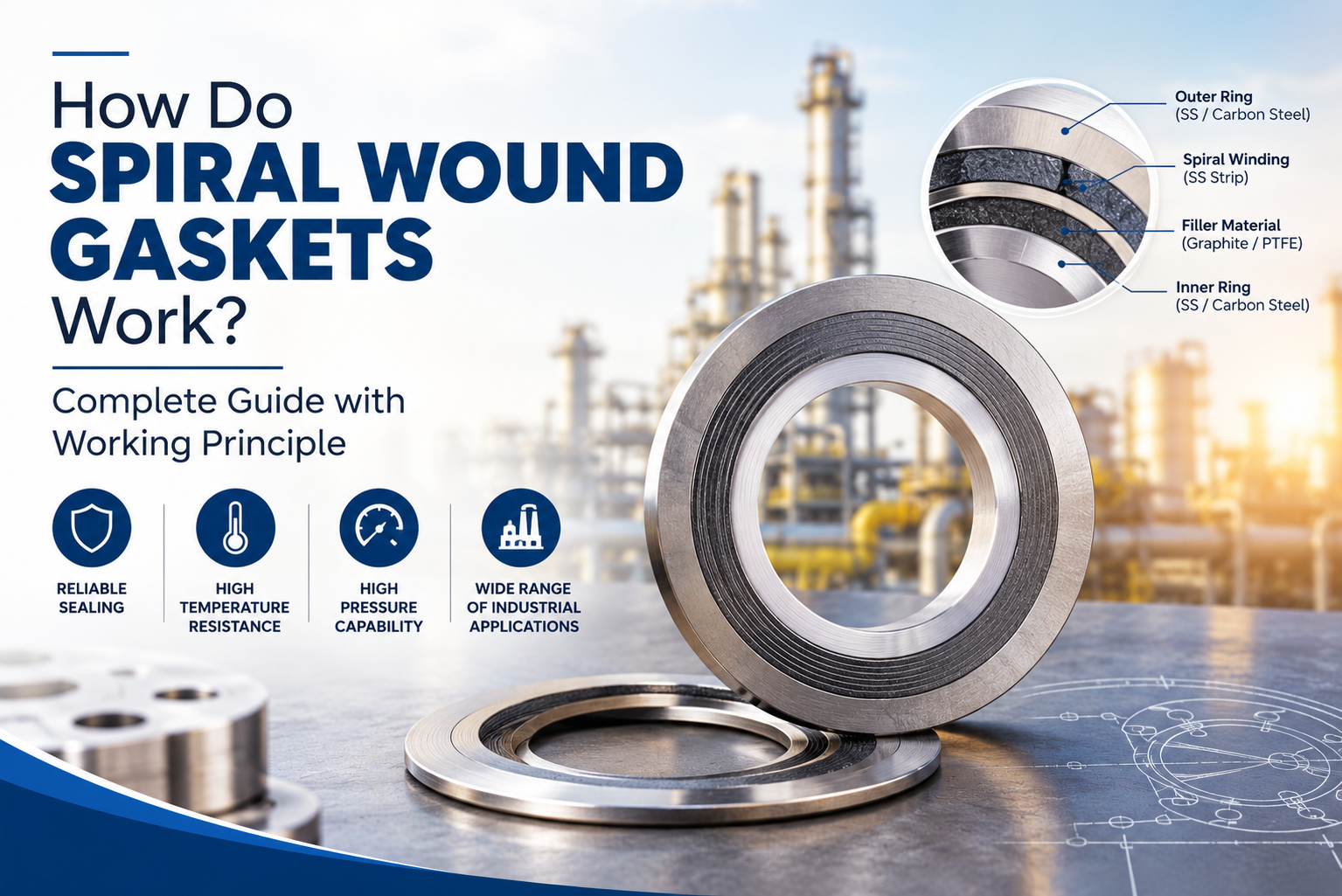
Spiral wound gaskets are made of controlled compression flexible filler material and metal winding wound together and are ideal for sealing flanges․ When the two flanges are bolted together‚ the gasket immediately compresses‚ conforming to any surface irregularities on the flanges․ Their metallic windings provide form‚ shape‚ and rigidity to the gasket while the filling material prevents leakage․
A spiral wound gasket is a semi-metallic sealing gasket that is formed by spirally winding a thin metal strip with a softer filler material. The metal allows for mechanical strength as well as the filler material to form the sealing face between the mating flange surfaces.
A typical spiral wound gasket may include:
The exact construction will depend on the application, pressure class, flange arrangement, process medium and temperature resistance needed. ASME B16.20 provides for metallic gaskets used for pipe flanges, such as spiral-wound metal gaskets, and includes pertinent materials, sizes, tolerances, and markings. The standard sets dimensional requirements for spiral-wound gaskets for use with flange standards like ASME B16.5 and ASME B16.47A.
The working principle of a spiral wound gasket is based on controlled compression and recovery. When a gasket is installed between two flanges, tightening the flange bolts applies compressive force to the gasket. This force compresses the spiral winding and filler material against the flange faces.
The sealing process can be understood in four stages:
Key fact: The gasket must receive sufficient and properly controlled compression to establish sealing without being excessively compressed or damaged.
Due to the filler material being in intimate contact with the sealing surfaces‚ the metal strip provides the structural stiffness‚ but the metal is not as conformable for small gaps between the flange seal surfaces․ A filler material has therefore been added between the layers of metal winding for improved conformability․
Common filler choices include:
The selection depends on factors such as:
A gasket suitable for one process medium may not be suitable for another, even when the dimensions are identical.
Several operating and installation parameters influence the final sealing result.
| Factor | Why it matters |
|---|---|
| Pressure | Determines the mechanical demand on the seal |
| Temperature | Influences filler and winding behaviour |
| Process medium | Determines material compatibility |
| Flange condition | Affects contact between gasket and flange |
| Bolt loading | Controls gasket compression |
| Gasket dimensions | Must match the flange arrangement |
| Filler material | Influences sealing and chemical suitability |
| Metal winding | Provides mechanical strength and support |
| Installation method | Affects load distribution across the gasket |
A gasket should therefore be selected according to the complete operating environment rather than only the nominal pipe size.
Spiral wound gaskets are used in industrial piping and equipment where reliable flange sealing is required.
Common applications include:
Their construction allows different combinations of metallic winding and filler materials to be considered for different service conditions.
Spiral wound gaskets can be configured in different ways depending on flange design and service requirements.
The choice of filler and winding material depends on factors such as pressure, temperature, process fluid, chemical compatibility, and operating conditions.
The correct gasket should be selected by evaluating the complete service conditions.
A practical selection checklist includes:
Key statement: The right spiral wound gasket is selected by matching gasket construction to the flange, process medium, pressure, temperature, and installation conditions.
Industrial buyers should verify technical and commercial details before placing an order.
| Parameter | What to confirm |
|---|---|
| Gasket type | Required spiral-wound configuration |
| Size | Nominal pipe size and gasket dimensions |
| Pressure class | Required flange rating |
| Filler | Graphite, PTFE, or specified material |
| Winding | Required metal grade |
| Inner ring | Required or not required |
| Outer ring | Required or not required |
| Standard | Applicable dimensional standard |
| Marking | Identification and traceability |
| Quantity | Required order quantity |
| Documentation | Inspection and material documents as specified |
These checks help reduce errors caused by selecting a gasket only from size or appearance.
Spiral wound gaskets are widely selected because their semi-metallic construction combines the mechanical strength of metal with the sealing characteristics of a softer filler.
Key advantages include:
Their actual performance, however, depends on correct material selection, gasket dimensions, flange condition, compression, and installation.
Ordinem Engitech supplies industrial gasket solutions based on requirements such as gasket size, flange standard, pressure class, filler material, winding material, and ring configuration. As Spiral Wound Gasket Manufacturers in India, the company focuses on providing gasket solutions suited to different industrial piping and equipment applications.
When selecting a manufacturer, buyers should consider factors such as dimensional accuracy, material suitability, gasket construction, and the ability to meet specific application requirements. Providing the correct technical specifications before ordering also helps ensure that the gasket supplied matches the intended application.
Spiral wound gaskets provide reliable flange sealing by combining controlled compression, flexible filler material, and metallic winding. Their performance depends on selecting the right gasket construction, filler, winding material, dimensions, and ring configuration for the operating conditions. Proper flange alignment, bolt loading, and installation are equally important for achieving effective sealing. For industrial applications, understanding these factors helps buyers select spiral wound gaskets that are suitable for their specific pressure, temperature, and process requirements.
A spiral wound gasket is compressed between the two opposing flange faces, when the flange-bolts are tightened. The filler material fills the small imperfections on the flange face, while the metal winding gives the gasket high compressive strength, and makes it less prone to changes in shape.
The spiral wound gasket consists of a spiral winding of metal, or metals, and a filler, which is normally graphite or PTFE. The particular winding material or combination of winding materials to be used will depend on temperature, pressure, chemical medium and other service conditions.
An inner ring supports the gasket's inside diameter providing sealing surface. This prevents the spiral winding from becoming dislocated under service conditions. This inner ring may also provide internal support, if the flange or system that the gasket is in requires it.
ASME B16.20 is an industry standard that covers metal gaskets used with piping flanges. It establishes the dimensions, tolerances, materials, and marking for spiral wound metal gaskets.
These include flange standards, size, pressure class, operating temperature, process medium, filler material, winding material and ring design. The specification must be suitable for the application and service environment, and not just for size.

 - +91 9737122555
 - info@ordinemengitech.com