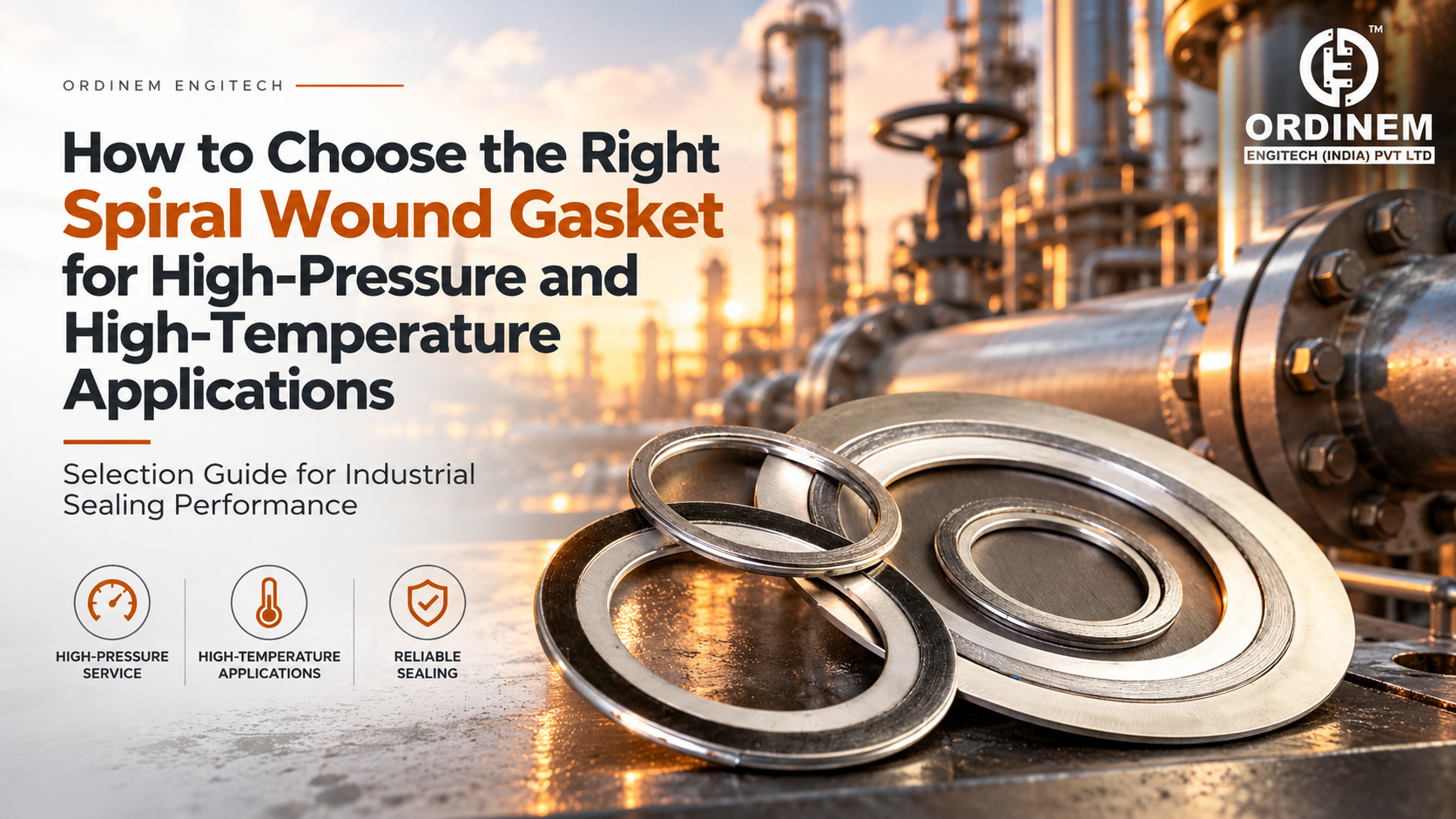
Choosing the right spiral wound gasket for high-pressure and high-temperature service requires knowledge of the pressure and temperature and chemical characteristics of the contained fluid, among other considerations involving gasket and flange size. Advantages of choosing an appropriate spiral wound gasket include fewer leaks and other benefits that help maintain industrial processes. Common applications for spiral wound gaskets include piping systems and heat exchangers, boilers, pressure vessels, and chemical plants.
This article explains spiral wound gaskets and their various materials, sizes, standards, and applications in different industries. Details about spiral wound gasket manufacturing by Ordinem Engitech (India) Pvt. Ltd., including standard and custom gaskets, are also provided.
A spiral wound gasket is a semi metallic gasket made by spirally winding a metal strip and filler material. Metal strip provides structural strength and resilience to the gasket. Filler material provides a seal between the surfaces of compatible flanges.
Spiral wound gaskets are commonly used in various industrial applications with variable and high pressure and temperature and other difficult conditions. Considerations for use of spiral wound gaskets include gasket material and other features, flange design, and installation methods. You can also explore our guide on how spiral wound gaskets work and their working principle.
A spiral wound gasket seals using compression between two flange faces.
When flange bolts are tightened according to approved procedures, the flange gasket is compressed. A material embedded in the flange gasket fills gaps in the mating surface. Adding metal to the gasket provides support and helps the gasket accommodate changes in joint conditions.
The standard sealing process is:
The effectiveness of the seal depends on gasket and flange surface conditions and the amount of force applied to the bolts, as well as process conditions such as pressure and temperature.
Key takeaway: A spiral wound gasket combines a resilient metal winding with a compressible filler to provide sealing performance in suitable industrial flange connections.
Spiral wound gaskets are used where flange connections must maintain a seal under demanding operating conditions. Their semi-metallic construction allows engineers to select different winding and filler combinations for specific process requirements.
These characteristics make spiral wound gaskets useful in industrial sealing applications. However, no single configuration is suitable for every pressure, temperature, chemical, or flange arrangement.
Spiral wound gaskets are classified by ring type, winding material, filler, and intended application. Classification helps consumers select the right spiral wound gasket for a specific flange and service application. For an overview of different styles and constructions, read our guide on spiral wound gasket types, materials, and benefits.
A spiral wound gasket with an outer centring ring is made up of a metallic sealing element and an outer ring.
The outer ring is used to position the gasket between flanges. Other uses of the outer ring include radial support and protection against excessive compression of the gasket.
This setup is common for suitable raised-face flanged joints that use gaskets with outer alignment rings.
This gasket includes metal windings and centering and backing rings made of packing material. The outer centering and backing rings center the gasket, and the inner backing ring supports the metal windings at the inner diameter. The inner ring helps prevent wrinkling inward and protects the sealing element from contact with process fluids. Some types of flanges, sizes, pressure ratings, and packing materials may require this type of gasket.
The correct configuration depends on the flange type, gasket dimensions, pressure class, filler material, and applicable standard.
Before selecting a configuration, verify:
The final configuration should be confirmed against the equipment drawing and manufacturer's technical recommendations.
A typical spiral wound gasket consists of a sealing element and may include inner and outer rings. Each component contributes to the gasket's positioning, structural stability, or sealing performance.
The outer ring, also known as the centring or guide ring, helps position the gasket correctly between the flange faces. It is commonly made from carbon steel or another specified material suitable for the application. The ring provides radial support and can help prevent excessive compression, depending on the design. Correct outer-ring dimensions are important for ensuring that the gasket fits the intended flange arrangement.
The inner ring supports the winding at the gasket's inside diameter.
Its functions include:
The inner-ring material must be compatible with the process medium and the intended operating conditions.
The sealing material consists of metal and filler layers. The metal layer provides strength and resilience to the gasket. The filler material helps provide a seal and block fluid flow between the flange faces. Types of metals used in the metal layers include stainless steel and Monel. Other specialty metals may be suitable for some gasket applications. Types of filler materials include flexible graphite and PTFE. Other filler materials may be suitable for certain gasket applications.
Common material options listed in the company's information include:
These materials have different mechanical and corrosion-resistance properties. They should not be treated as interchangeable.
For example, a stainless steel grade suitable for one process medium may not provide the required resistance in another chemical environment. Specialised alloys may be considered when the application requires different corrosion-resistance characteristics.
The winding and ring materials should be specified separately where necessary, because the requirements for each component may differ.
The company information identifies the following filler materials:
| Filler Material | General Characteristics | Important Selection Consideration |
|---|---|---|
| Flexible graphite | Commonly used in suitable elevated-temperature applications | Check chemical compatibility and oxidation conditions. |
| PTFE | Offers resistance to many chemicals | Confirm temperature limitations and compatibility with the process medium. |
| Mica | Used in selected applications requiring appropriate thermal properties | Confirm the grade and temperature suitability. |
| Ceramic | Listed in the company's filler colour-code information | Confirm the available product construction and application limits. |
The company's material information also refers to composite asbestos fillers. Asbestos-containing materials present significant health hazards and are restricted or prohibited in many jurisdictions and applications. Any such material must be assessed against applicable laws, safety requirements, and current product availability before consideration.
Important: Filler selection must be based on the actual process medium, temperature, pressure, and gasket construction rather than on a material's general properties alone.
Material identification facilitates the identification of gasket materials during inspection, installation and replacement by engineers and the maintenance team. Ordinem Engitech claims to utilize laser marking to mark gasket data and an in-house powder-coating process for colour coding the outer rings.
The following table reproduces the material and outer-ring colour associations supplied in the company's product information.
| Metallurgy or Ring Material | Outer-Ring Colour Listed |
|---|---|
| Stainless steel 304 | Yellow |
| Stainless steel 316 | Green |
| Stainless steel 321 | Turquoise |
| Stainless steel 347 | Blue |
| Alloy 20 | Black |
| Carbon steel | Silver |
| Hastelloy B | Brown |
| Hastelloy C | Beige |
| Inconel | Gold |
| Monel | Orange |
| Nickel | Red |
| Titanium | Purple |
These colours should be checked against the applicable edition of the relevant standard and the company's approved marking procedure before they are used as a definitive identification reference.
The company's supplied filler colour-code information includes the following associations.
| Filler Material | Stripe Colour Listed |
|---|---|
| Mica paper | Pink |
| Graphite | Grey |
| PTFE | White |
| Ceramic | Light green |
Colour coding helps support identification, but it should not replace verification of the actual gasket marking, material specification, and accompanying documentation.
Correct identification helps reduce the risk of installing a gasket with unsuitable materials.
For critical applications, buyers and maintenance teams should verify:
Ordinem Engitech's stated use of laser marking and outer-ring colour coding supports the identification process for its spiral wound gasket products.
Choosing a spiral wound gasket requires more than matching its nominal size. The complete specification must be compatible with the flange connection and operating conditions.
Identify the normal operating pressure, maximum design pressure, and any significant pressure fluctuations. The gasket must be suitable for the intended flange pressure class and joint design. Pressure class alone does not establish the allowable operating pressure of every gasket at every temperature.
Record the normal operating temperature, maximum and minimum temperatures, and any significant temperature changes during start-up or shutdown.
The winding, filler, and ring materials must remain suitable under the specified conditions.
The process medium influences the chemical compatibility requirements for the winding, filler, and rings.
Provide information about:
These details help determine which material combination should be considered.
The gasket must fit the intended flange connection.
Confirm the nominal size, flange type, pressure class, facing, inside diameter, outside diameter, and thickness. Also verify whether the application requires an inner ring, an outer ring, or both.
Incorrect dimensions or an unsuitable configuration can affect compression and sealing performance.
Spiral wound gasket dimensions must match the flange arrangement and specified construction. Thickness is one of several dimensional parameters that should be checked before purchasing a gasket.
The existing Ordinem Engitech product information lists the following thickness values.
| Sr. No. | Nominal Thickness | Compressed Thickness | Inner/Outer Thickness Stated in the Supplied Information |
|---|---|---|---|
| 1 | 3.2 mm | 2.4–2.6 mm | 2.0–2.2 mm |
| 2 | 4.5 mm | 3.2–3.4 mm | 3.0–3.3 mm |
These values are based on the information provided for this article. They should be verified against the manufacturer's technical drawings before publication or use in an engineering specification.
Gasket thickness affects the fit and compression of the sealing element within the flange assembly. A gasket that does not match the specified dimensions may not achieve the intended compression or fit correctly between the flange faces.
Before ordering, verify:
The correct dimensions should be confirmed using the approved drawing or specification for the intended application.
Spiral wound gasket selection involves both gasket manufacturing requirements and the standards governing the associated flange connection. Ordinem Engitech's supplied company information lists API 601, ASME B16.20, ASME B16.5, ASME B16.47A, ASME B16.47B, DIN EN 1092-1, and BS EN 1092.
These references do not all serve the same purpose. Some address gasket requirements, while others concern flange dimensions, pressure classes, or flange systems.
ASME B16.20 is an important standard covering metallic gaskets for pipe flanges, including spiral wound gaskets. It addresses requirements such as dimensions, materials, tolerances, and marking for applicable gasket types.
The flange standard determines important aspects of the mating connection, including dimensions and pressure-class requirements. The gasket must be compatible with the specified flange system. A gasket designed for one arrangement should not automatically be assumed suitable for another.
Before placing an order, confirm:
Key takeaway: Verify both the gasket specification and the mating flange requirements before approving a spiral wound gasket for service.
Spiral wound gaskets are used in industrial applications where suitable flange connections must maintain sealing performance under specified pressure, temperature, and process conditions.
Yes. Spiral wound gaskets may be used in compatible heat exchanger flange connections where the specified gasket construction meets the equipment's operating requirements. Heat exchangers can experience temperature fluctuations and different process conditions across their systems. Gasket material, dimensions, and construction should therefore be selected for the specific service.
Spiral wound gaskets are used in suitable oil and gas piping systems and process equipment.
The winding and filler materials must be compatible with the hydrocarbons, gases, contaminants, operating temperatures, and pressure conditions involved.
Yes, when the selected construction is compatible with the chemicals and operating conditions.
Material selection is especially important where the process involves corrosive fluids, varying concentrations, or elevated temperatures.
Spiral wound gaskets can be used in suitable boiler, pressure vessel, and reactor flange connections.
The required gasket specification must match the equipment design, flange arrangement, pressure, temperature, and applicable engineering requirements.
An industrial sealing application is not always suitable for sealing with a spiral wound gasket. Other types of gaskets may be appropriate for the specific equipment design and operating conditions.
These products should be evaluated according to their own specifications rather than treated as direct replacements for spiral wound gaskets.
A systematic selection process helps engineers, maintenance teams, and purchasing professionals identify a gasket that meets the requirements of the intended flange connection.
For standard and custom-made gasket requirements, provide the following information wherever applicable.
| Information Required | Details to Provide |
|---|---|
| Gasket type | Spiral wound gasket |
| Nominal size | Required pipe or flange size |
| Flange standard | Applicable flange specification |
| Pressure class | Required flange pressure class |
| Operating pressure | Normal and maximum design conditions |
| Operating temperature | Normal and maximum temperature |
| Process medium | Fluid or gas and relevant chemical details |
| Winding material | Required metallic grade |
| Filler material | Graphite, PTFE, mica, ceramic, or another specified option, subject to availability and suitability |
| Ring configuration | Inner ring, outer ring, or both, as required |
| Dimensions | Required thickness and any non-standard dimensions |
| Quantity | Number of gaskets required |
| Documentation | Drawings, material certificates, or inspection requirements |
Providing these details helps the manufacturer assess the requirements before confirming the proposed gasket specification.
Incorrect gasket selection can lead to leakage, premature deterioration, installation difficulties, or unsuitable performance.
Manufacturing equipment, material selection, dimensional control, and product identification all contribute to producing gaskets that meet their specified requirements.
Ordinem Engitech (India) Pvt. Ltd., based in Ankleshwar, Gujarat, states that its manufacturing facility uses CNC-automatic and semi-automatic machinery for spiral wound gasket production.
The company describes capabilities for manufacturing standard and custom-made spiral wound gaskets in different sizes, types, and materials. Its supplied company information also identifies a CNC-automatic gasket-cutting system for intricate shapes, typical profiles, and larger gaskets made from suitable soft and fibre materials. These capabilities address different manufacturing requirements, from spiral wound gasket production to the cutting of other gasket types.
The company states that it uses an in-house laser-marking system to mark spiral wound gaskets with relevant identification information, including size and material details. It also describes an in-house powder-coating system for outer-ring colour coding in accordance with applicable requirements. Correct identification helps buyers and maintenance teams verify the gasket specification during inspection, installation, and replacement.
According to the company information provided, Ordinem Engitech is ISO 9001:2015 certified. The company also states that it selects raw materials according to specified quality requirements and uses modern manufacturing equipment to support consistent production.
For a particular order, buyers should confirm the required material documentation, inspection records, and any project-specific compliance requirements.
A spiral wound gasket creates a seal between compatible flange surfaces to help prevent the leakage of liquids and gases. It combines a metallic winding with a filler material to provide the required sealing performance under specified operating conditions.
The correct gasket depends on the operating pressure, flange pressure class, gasket size, materials, and construction. The selection must comply with the applicable engineering requirements and the manufacturer's specifications.
Flexible graphite is commonly used in many elevated-temperature industrial applications. Its suitability depends on the process medium, oxidation conditions, and operating temperature. Always verify the manufacturer's technical limits.
The outer ring helps centre the gasket between the flange faces and provides external support. The inner ring supports the winding at the inside diameter and helps reduce inward buckling. Their requirements depend on the gasket design and applicable standard.
Yes, provided that the winding, rings, and filler are compatible with the process medium. Chemical composition, concentration, temperature, and exposure conditions must be considered during material selection.
ASME B16.20 is an important reference for metallic gaskets used with compatible pipe flanges. The applicable gasket and flange standards should be verified against the equipment specification and project requirements.
They can be used in compatible heat exchanger flange connections where the gasket construction meets the equipment's operating requirements. The correct materials, dimensions, and flange specifications must be confirmed.
The company states that it manufactures standard and custom-made spiral wound gaskets in different sizes, types, and materials. Confirm the feasibility of the required dimensions and construction with the company before placing an order.
Select a gasket that matches the operating conditions and flange specification. Inspect the flange faces, ensure correct alignment, and follow the approved bolt-tightening procedure. Investigate the underlying cause if leakage continues.
Evaluate the manufacturer's material options, dimensional capabilities, technical documentation, product identification methods, and quality-management processes. Confirm that the proposed gasket meets the requirements of the intended application before purchasing.
Choosing the right spiral-wound gasket for high-temperature, high-pressure applications depends on factors such as application requirements, gasket materials, gasket shapes and sizes, and ring types, as well as other specifications. Proper choice of winding and filler materials and other flange design and assembly features can help ensure an effective gasket seal. Ordinem Engitech (India) Pvt. Ltd. offers information about its manufacturing capabilities for standard and custom spiral-wound gaskets and laser and color coding identification services for gasket materials. Customers are asked to supply complete details and approve designs before placing an order.
Systematic approaches to selecting gaskets can help engineers and procurement and other maintenance professionals select appropriate gasket materials for their applications.

 - +91 9737122555
 - info@ordinemengitech.com